

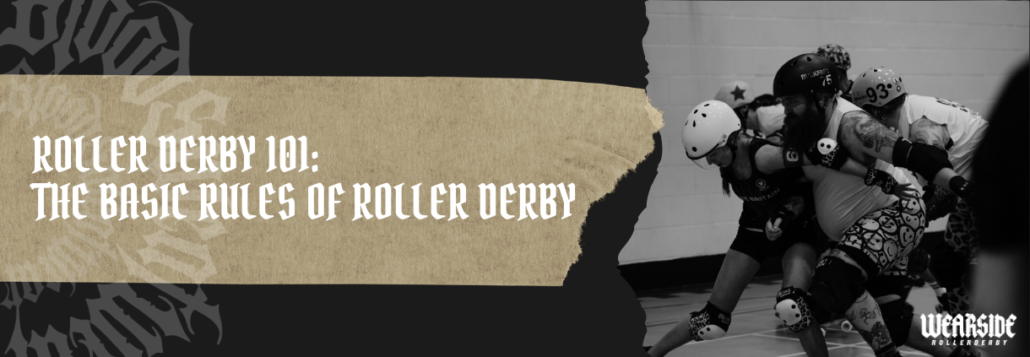
Roller Derby 101: The Basic Rules of Roller Derby
You get the core idea: Jammers score points by lapping blockers. But if you’ve watched a bout and wondered why the whistle just blew, or what exactly sent that skater to the penalty box, you’re not alone. Sometimes, the people skating wonder the same thing.
At first glance, the rules of roller derby can seem overwhelmingly complicated (entirely understandable given the official rulebook’s depth and detail), but if you look past the specifics, you’ll find a set of refreshingly logical core principles, all designed with the singular purpose of maintaining a game that is safe, fair, and competitive.
Now, let’s unravel those principles and break down the essential rules that create the fast-paced, strategic flow of a bout.
1. The Track and the Players
- The Track: A flat oval, roughly the size of a basketball court. It has an inside line and an outside line that mark the track boundary. Skaters must stay in bounds.
- The Pack: This is not just a name for the blockers; the “Pack” is a defined, moving group. It’s made of the largest number of blockers from both teams who are skating within 10 feet of each other. The entire game revolves around this entity.
- Engagement Zone: This is the area 20 feet ahead of and behind the foremost and rearmost pack skaters. This is the only area where blockers can legally engage, or block, the opposing jammer. If you’re outside this zone, you are out of play.
2. How Scoring Really Works
So we know jammers score by lapping opponents. Let’s get into the finer details:
- Initial Pass: On a jammer’s first pass through the pack, they earn no points. They’re just fighting for position and that precious lead jammer status.
- Earning Points: After breaking through the pack once, the jammer starts their “scoring pass.” On each subsequent pass, they earn one point for every opposing blocker they legally lap and pass while in bounds and upright.
- “Passing” a Blocker: This does not just mean skating by them. The jammer must be in bounds, have all their wheels on the floor, and pass the blocker’s hips to be awarded the point.
- Lead Jammer: The first jammer to break through the pack legally and in bounds becomes the lead jammer, and the referee will point at them with both arms to signify this. This jammer now has the strategic power to call off the jam early by repeatedly tapping their hands on their hips.
3. The Big One: Penalties and the Penalty Box
Penalties keep the game safe. Most penalties result in 30 seconds in the penalty box, but with jams running for a maximum of two minutes, this leaves your team seriously short-handed.
Common penalties include:
- Blocking with Illegal Zones: You can only block with your shoulders, torso, hips, and upper legs, meaning above mid-thigh. Using your head, elbows, forearms, hands, or lower legs is a penalty.
- Blocking to the Back: You cannot initiate a block to an opponent’s back, or to the back of their shoulders, hips, or legs. The game is played face-to-face, or side-to-side.
- Blocking Out of Bounds: If you step out of bounds, with all eight wheels over the line, you become a “non-skater.” You cannot engage an opponent from out of bounds. You must re-enter safely behind them.
- Multi-Player Blocks: You can’t gang up on a single opponent; this includes joining arms with or otherwise assisting a teammate by pushing or pulling them to increase their blocking force.
- Cutting the Track: If a skater re-enters the track from out of bounds in front of an opponent they were initially behind, they have “cut” and will be sent to the box. This prevents skaters from gaining an unfair positional advantage.
- Back Blocking: You cannot hit someone from behind; it’s dangerous and illegal.
4. Key Gameplay Situations
- No Pack/Out of Play: If blockers get too spread out (more than 10 feet between skaters) the referees will call “NO PACK.” Skaters must then yield and allow the other team to reform a pack.
- Power Jam: This happens when one jammer is in the penalty box. The other team has a huge scoring opportunity with only one jammer on the track. Strategy shifts instantly, turning into aggressive offense for the team with the jammer, and desperate, tight defense for the team without.
- Recycling: If a blocker legally knocks the opposing jammer out of bounds, a teammate will often “recycle” them. This means skating clockwise, the opposite derby direction, to force the jammer to re-enter the track behind the pack, and causing them to lose ground.
The Spirit of the Rules
It’s easy to get lost in the details, but remember this: The rules exist to minimise dangerous play and to maximise strategic, athletic competition. They transform what could be a simple brawl into a fast, physical chess match.
Next time you watch a game, you’ll see why a blocker suddenly stops skating; because they’re yielding for a “No Pack” call. You’ll understand the groan when a team’s star jammer takes a seat in the penalty box. And you’ll better appreciate the brilliant move of a jammer legally cutting inside to score and avoiding that dreaded whistle blow that comes from a cut track.




Leave a Reply
Want to join the discussion?Feel free to contribute!