

Kit Guide: Wheels
You’ve got your skates, your gear, and the heart of a fighter. But between you and that perfect apex jump or game-saving plow stop is a crucial piece of equipment that often gets overlooked: your wheels.
Think of them as your tires. You wouldn’t drive a race car on snowy treads, right? The same logic applies here. Choosing the right wheels isn’t just gear-nerding; it’s about unlocking your potential and adapting your machine to the battlefield.
Let’s break down the three key factors: Hardness, Size, and Surface. Plus, we’ll talk about the art of the mix.
1. Hardness: Feeling the Floor
Hardness is measured on the Durometer A Scale, shown as a number followed by an “A.” The lower the number, the softer the wheel. The higher the number, the harder.
Softer Wheels (88A – 93A)
These are your grippy monsters. They deform slightly against the floor, creating more surface contact and traction. Perfect for slicker surfaces (polished concrete, some sport courts), or if you’re a newer skater wanting more stability. The trade-off? More grip means more rolling resistance, so you might feel a bit slower and have to work harder for slides.
Medium Wheels (94A – 97A)
The Swiss Army knives of derby. They offer a fantastic balance of grip and slide, making them the most popular choice for general indoor use on typical derby floors (wood, polished concrete, sport tile). They provide enough stick for powerful pushes and stops, but enough give to slide during hits or lateral moves.
Hard Wheels (98A – 103A)
These are your slippery speedsters. They deform less, offering minimal grip and maximum slide. Ideal for very sticky floors (like some rubberized surfaces) where you need to break traction to move laterally or plow. Hard wheels have less rolling resistance, so they can feel faster on supportive floors. Caution: On a slick floor, these can feel like skating on marbles.
Your weight plays a role here, too. Heavier skaters will compress wheels more, effectively making them grippier. A lighter skater might need a softer wheel to achieve the same level of grip.
2. Size: The Physics of Push
Diameter (Height)
Wheels are usually measured in millimeters (mm). Smaller wheels (59mm-62mm) offer a lower center of gravity, quicker acceleration, and are often favored by jammers and agile blockers. Larger wheels (63mm-65mm) have a higher top speed and roll over cracks and debris more easily, but can feel a bit less nimble.
Width (Profile)
Narrow wheels are lighter and have less contact with the floor, making them easier to slide and pivot. Wider wheels provide more stability, more grip, and a smoother ride, which can be kinder on your knees.
Most modern derby wheels are in the 59mm-65mm diameter range, with a medium width. It’s a game of millimeters, but the feel is distinct.
3. Surface: Indoor vs. Outdoor
Indoor Wheels
Designed for smooth, finished surfaces. They are typically made of urethane with the hardness ranges discussed above. Using indoor wheels outside will grind them down into expensive dust in a single session.
Outdoor Wheels
Made for asphalt, rough concrete, and tennis courts. They are much softer (78A-85A) to absorb the vibrations and bumps of rough terrain, and are often wider. They will feel impossibly slow and gummy on a smooth derby track.
Keep a separate set for outdoor skating. Your knees and your wallet will thank you.
4. The Art of Mixing Wheels
This is where you become a skate mechanic and tailor your setup to your position, style, and the specific floor.
The classic strategy is the Grip-Slide Mix.
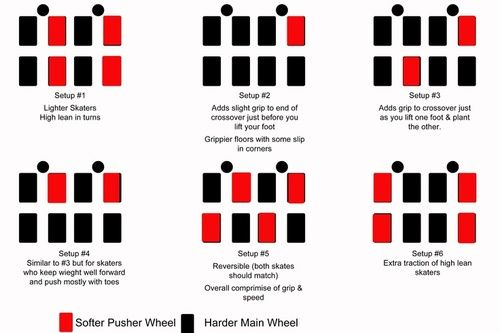
- More Grip on the Left: Some skaters put slightly softer (grippier) wheels on their left side to help with counter-clockwise turns and crossovers, especially if they struggle with traction on corners.
- More Slide on the Right: Slightly harder (slippier) wheels on the right side can facilitate easier plow stops and lateral slides.
You can also mix by position:
- Blockers: Might run a grippier setup overall to hold their ground, or mix for quick lateral movement.
- Jammers: Often opt for a harder, faster setup to slip through holes, or a balanced mix for explosive acceleration and cornering stability.
Start conservative. Try mixing just two wheels (e.g., a 95A on your left front and back, with 93As on the right). Feel the difference, then adjust. Your perfect mix might change from venue to venue!
Check out this handy infographic for examples of how your wheel setup affects performance.
Your Wheely Important Action Plan:
- Know Your Floor. Is it slick, polished concrete or a sticky, rubberized sport court? Ask veterans what they use.
- Assess Your Style and Position. Do you need to hold the line or slip through it?
- Borrow Before You Buy! This is the golden rule of derby. Ask your league mates if you can try a different setup during warm-ups. Feel is everything.
- When in doubt, start with a middle-of-the-road setup (like a 95A all around) and adjust from there.
Your wheels are the final, critical interface between your will and the track. Don’t be afraid to experiment. The right setup won’t just change your skate; it’ll change your game.




Leave a Reply
Want to join the discussion?Feel free to contribute!