

Kit Guide: Wheels

You’ve got your skates, your gear, and the heart of a fighter. But between you and that perfect apex jump or game-saving plow stop is a crucial piece of equipment that often gets overlooked: your wheels.

Think of them as your tires. You wouldn’t drive a race car on snowy treads, right? The same logic applies here. Choosing the right wheels isn’t just gear-nerding; it’s about unlocking your potential and adapting your machine to the battlefield.

Let’s break down the three key factors: Hardness, Size, and Surface. Plus, we’ll talk about the art of the mix.

1. Hardness: Feeling the Floor

Hardness is measured on the Durometer A Scale, shown as a number followed by an “A.” The lower the number, the softer the wheel. The higher the number, the harder.

Softer Wheels (88A – 93A)

These are your grippy monsters. They deform slightly against the floor, creating more surface contact and traction. Perfect for slicker surfaces (polished concrete, some sport courts), or if you’re a newer skater wanting more stability. The trade-off? More grip means more rolling resistance, so you might feel a bit slower and have to work harder for slides.

Medium Wheels (94A – 97A)

The Swiss Army knives of derby. They offer a fantastic balance of grip and slide, making them the most popular choice for general indoor use on typical derby floors (wood, polished concrete, sport tile). They provide enough stick for powerful pushes and stops, but enough give to slide during hits or lateral moves.

Hard Wheels (98A – 103A)

These are your slippery speedsters. They deform less, offering minimal grip and maximum slide. Ideal for very sticky floors (like some rubberized surfaces) where you need to break traction to move laterally or plow. Hard wheels have less rolling resistance, so they can feel faster on supportive floors. Caution: On a slick floor, these can feel like skating on marbles.

Your weight plays a role here, too. Heavier skaters will compress wheels more, effectively making them grippier. A lighter skater might need a softer wheel to achieve the same level of grip.

2. Size: The Physics of Push

Diameter (Height)

Wheels are usually measured in millimeters (mm). Smaller wheels (59mm-62mm) offer a lower center of gravity, quicker acceleration, and are often favored by jammers and agile blockers. Larger wheels (63mm-65mm) have a higher top speed and roll over cracks and debris more easily, but can feel a bit less nimble.

Width (Profile)

Narrow wheels are lighter and have less contact with the floor, making them easier to slide and pivot. Wider wheels provide more stability, more grip, and a smoother ride, which can be kinder on your knees.

Most modern derby wheels are in the 59mm-65mm diameter range, with a medium width. It’s a game of millimeters, but the feel is distinct.

3. Surface: Indoor vs. Outdoor

Indoor Wheels

Designed for smooth, finished surfaces. They are typically made of urethane with the hardness ranges discussed above. Using indoor wheels outside will grind them down into expensive dust in a single session.

Outdoor Wheels

Made for asphalt, rough concrete, and tennis courts. They are much softer (78A-85A) to absorb the vibrations and bumps of rough terrain, and are often wider. They will feel impossibly slow and gummy on a smooth derby track.

Keep a separate set for outdoor skating. Your knees and your wallet will thank you.

4. The Art of Mixing Wheels

This is where you become a skate mechanic and tailor your setup to your position, style, and the specific floor.

The classic strategy is the Grip-Slide Mix.

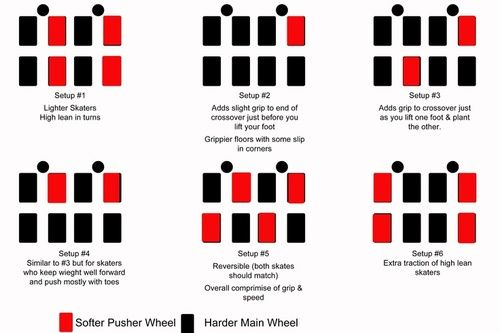
  • More Grip on the Left: Some skaters put slightly softer (grippier) wheels on their left side to help with counter-clockwise turns and crossovers, especially if they struggle with traction on corners.
  • More Slide on the Right: Slightly harder (slippier) wheels on the right side can facilitate easier plow stops and lateral slides.

You can also mix by position:

  • Blockers: Might run a grippier setup overall to hold their ground, or mix for quick lateral movement.
  • Jammers: Often opt for a harder, faster setup to slip through holes, or a balanced mix for explosive acceleration and cornering stability.

Start conservative. Try mixing just two wheels (e.g., a 95A on your left front and back, with 93As on the right). Feel the difference, then adjust. Your perfect mix might change from venue to venue!

Check out this handy infographic for examples of how your wheel setup affects performance.

Your Wheely Important Action Plan:

  1. Know Your Floor. Is it slick, polished concrete or a sticky, rubberized sport court? Ask veterans what they use.
  2. Assess Your Style and Position. Do you need to hold the line or slip through it?
  3. Borrow Before You Buy! This is the golden rule of derby. Ask your league mates if you can try a different setup during warm-ups. Feel is everything.
  4. When in doubt, start with a middle-of-the-road setup (like a 95A all around) and adjust from there.

Your wheels are the final, critical interface between your will and the track. Don’t be afraid to experiment. The right setup won’t just change your skate; it’ll change your game.


Roller Derby 101: A Guide to Roller Derby Kit

When you step into the world of roller derby, there’s one crucial task to tick off before you start learning to skate or mastering a shoulder block; you need to gear up.

The right kit isn’t merely about safety, though that is its paramount job. It’s also about confidence, performance, and becoming part of a tradition that’s as much about personal expression as it is about athleticism.

For a newcomer, the list of required gear can seem a bit daunting, a jumble of straps and strange names, but each piece has a vital role to play in your journey from spectator to skater.

Let’s walk through the essential armoury of a roller derby player, so you can hit the track with knowledge and a bit of style.

The Foundation: Skates and Plates

Your boots and wheels are your most personal and critical pieces of equipment, the direct interface between you and the sport.

  • Skates: You’ll start with a basic, supportive boot, often something like the famous Riedell R3 or its equivalents, which are the dependable workhorses of the derby world. As you progress, you might move to a boot with a more customised fit and agility. The key is ankle support and a snug, comfortable fit that doesn’t leave any room for your foot to slide around.
  • Plates: This is the chassis of your skate, the metal or nylon assembly that holds your wheels and attaches to your boot. Its flexibility, or action, affects your agility and stability. Beginners benefit from a stable, forgiving plate while they’re finding their feet, quite literally.
  • Wheels: Wheels aren’t one-size-fits-all; they’re chosen for the court surface and your role. A gummy, soft wheel (with a lower durometer number) grips a dusty wooden floor beautifully, while a harder, slicker wheel (with a higher number) glides faster on polished concrete. Many skaters keep a mixed set, or a ‘durometer mix’, for the perfect balance of grip and slide.

    We’ll dive a bit deeper into the whole durometer thing in another post.

The Essential Armour: Safety Gear

This is the non-negotiable part of your kit, your personal protective equipment that lets you train hard and play harder with confidence.

  • Helmet: A properly fitted, certified dual-impact helmet is your most important piece of gear. It should sit level on your head, snug without being painful, with the strap securely fastened. You can decorate it with tape for your scrimmage colour, or cover it with a fun fabric sleeve; just make sure it’s always on and properly secured.
  • Mouth Guard: A custom-fitted, boil-and-bite mouth guard is essential. It doesn’t just protect your teeth; it can help prevent concussion by cushioning your jaw. The cheap, one-size-fits-all types aren’t enough for a contact sport.
  • Knee Pads: These are your best friends. You’ll fall, and you’ll fall often, especially at the start. A good set of bulky, padded knee pads with a hard plastic cap, like the ones favoured by skateboarders, will save you from a world of pain and let you practise knee taps and falls safely.
  • Elbow Pads: Similar in principle to knee pads, they protect your elbows during falls and can prevent painful ‘rink rash’ and more serious impacts.
  • Wrist Guards: These are crucial for instinctive, outstretched hands during a fall. They support the wrist and disperse the impact across a plastic splint, helping to prevent sprains and fractures.

The Practical Extras

Once you’ve got the fundamentals, a few extra items will make your life much easier.

  • Toe Stops: Those rubber stoppers at the front of your plate aren’t just for braking. For many players, especially jammers, they’re essential tools for quick directional changes, agility moves, and pushing. You’ll want to set them at a height and choose a style that suits your skating.
  • Bearings: These little metal rings inside your wheels are what let them spin freely. Keeping them clean and lubricated is a basic piece of skate maintenance that ensures a smooth, fast roll.
  • Skate Tool: This multi-wrench is your derby Swiss Army knife. You’ll use it for everything: adjusting toe stops, tightening loose wheels, and generally keeping your skates in fighting shape. Never leave home without it.
  • Gear Bag: You’ll need a sturdy, ventilated bag to haul all this kit to and from practice. Trust us, a dedicated bag’s a lifesaver.

A Note on Style and Identity

While safety is crucial, roller derby has always had a strong streak of individuality. Through your kit, you have a chance to show off your style and personality. Your kit becomes an extension of your track persona; this is colourful laces, themed skate straps, custom painted helmets, and snazzy wheel colours come in.

Your gear starts as protection, but as you wear it in, scuff it up, and make it yours, it becomes a part of your derby identity.

Choosing your first set of gear can feel like a big step, but remember that every single skater on your team’s been through the same process. Don’t be afraid to ask veterans for advice on fit and brands; they’re a wealth of knowledge. If you’re happy to get up close and personal with someone else’s stinky kit, you can even try some on for size. Your local skate shop, if you’re lucky enough to have one. will also be an invaluable resource.

In the end, your kit is what enables you to participate fully in this incredible sport. It’s the shell that lets you push your limits, fall safely, and get back up again, ready to learn more.

So gear up, and get ready to roll!